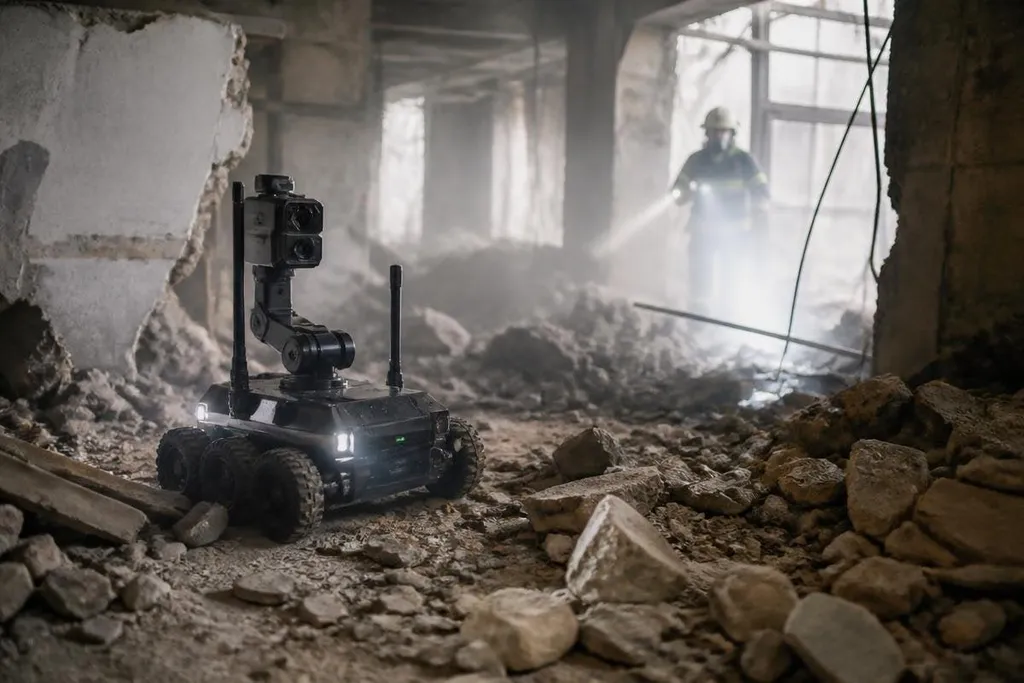
A disaster robot may enter a damaged building when smoke blocks cameras, dust covers sensors, and the radio link drops. These machines will be judged by what they can do in those conditions, not by a smooth demonstration in an empty room.
For emergency teams, the useful question is practical: can the robot find people, send clear information, and return without creating another problem?
Quick read
- Local control matters when the wireless link is weak or gone.
- A sensor mix gives better results than a single camera in smoke and dust.
- Recovery, repair, and safe shutdown deserve as much attention as movement.
The robot needs a plan when the link breaks
Many disaster robots depend on teleoperation. An operator sends commands while watching video and sensor data from a safe position. That setup gives people control, but it also makes the network part of the robot’s safety system.
A damaged building can block radio signals through concrete, steel, water, or underground layouts. A strong disaster robot should keep its last safe action, stop in a known way, and record its position when the operator loses contact. It also needs a clear method for reconnecting without a sudden motor command.
Local software can handle small tasks while the operator deals with the larger problem. The robot might hold its heading, avoid a drop, or return along a mapped route. Those actions need careful limits. A robot that keeps moving after its sensor data goes stale can turn a rescue tool into an obstacle.
This is where autonomy needs a plain definition. It means the robot can make a limited choice without waiting for a new command. It does not mean the robot understands a collapsed building or can replace a trained responder.
Sensors must agree before the robot acts
Cameras give operators useful detail, but smoke and darkness can remove that view. Thermal cameras can show heat differences, while LiDAR measures distance by sending out laser pulses. Inertial sensors track changes in motion, even when the robot cannot see enough to build a map.
Each sensor has a weak point. Thermal images can confuse warm machinery with a person. LiDAR can lose detail through smoke or dust. Motion sensors drift over time.
New designs should compare these inputs and show the operator when they disagree, rather than hiding uncertainty behind a clean-looking map.
A robot also needs to report what it cannot sense. A blank camera image may mean darkness, a covered lens, or a failed cable. Those cases call for different actions, so the control screen should name the fault and show the last reliable reading.
A disaster robot’s route, sensor view, and operator input matter as much as the demo clip. Robot24.com disaster robotics reporting can tie a claim to the test site, date, task, and measured result, giving you a firmer basis before the next section looks at movement.
Movement is only half the job
Tracks can cross loose ground, while legs can step over gaps and debris. Wheels use less power on clear floors. The right layout depends on the site, so a rescue team needs a robot matched to its work rather than a machine chosen for appearance.
The robot must also carry the tools that make its visit useful. Those may include a thermal camera, a microphone, a gas sensor, a light, or a small arm. Every added tool increases weight, power use, and the number of parts that can fail.
Recovery matters too. A robot that tips over beside a victim may block access. Teams should ask how it rights itself, how a person can move it, and whether the operator can shut down each motor from a safe distance. A tether, lifting point, and manual release can matter more than another software feature.
The hard part is repeatable work. A machine that reaches a test area once has shown a visit, not a rescue system. Teams need records from poor signal, low light, uneven ground, wet surfaces, and damaged structures before they can judge the design.
A field checklist for emergency teams
Use these points when comparing a robot for search, inspection, or first response:
- Signal loss: Check what the robot does after the control link drops, how long it waits, and how it reports the event.
- Sensor faults: Cover a camera, add dust, or remove one sensor in a controlled test. The system should name the fault instead of showing false confidence.
- Operator load: Count the screens, controls, and alerts needed for one mission. A tired operator has less attention for rescue decisions.
- Recovery: Test a tip-over, a blocked track, and a dead motor. Record whether people can move the robot without special equipment.
- Maintenance: Ask how teams replace batteries, cables, wheels, tracks, and sensor covers in the field.
- Mission proof: Request results from repeated tests that match the intended site, not only a clean indoor course.
I’d skip any robot whose maker can show movement but cannot explain failure, recovery, and repair.
Field trials are the next step for disaster robots, with tests built around lost links, damaged sensors, and blocked routes. Until those tests are public, a polished rescue demo remains a starting point, not proof that the robot is ready.